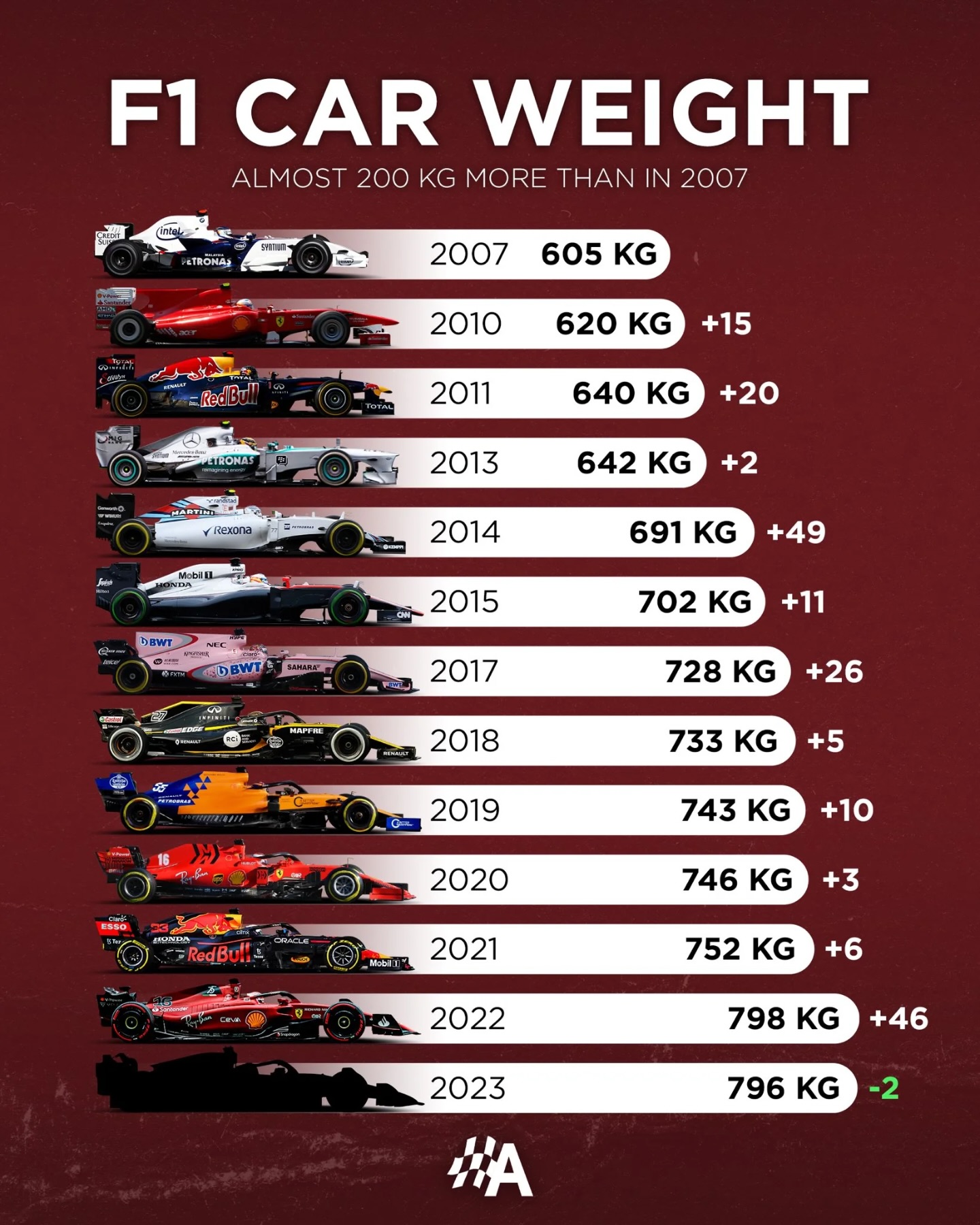

Minimum weight limits were originally introduced to prevent teams from compromising safety through excessively light or structurally inadequate construction. In the early years of F1, engineering analysis tools were less advanced, making unsafe designs more likely.
Today, improved simulation and structural analysis have reduced those risks, and minimum weight regulations are largely intended to control costs and prevent expensive development of ultra-lightweight components.
Before the introduction of KERS, it was relatively easy to build an F1 car to the minimum weight. The addition of KERS, particularly its battery systems, made achieving the minimum weight more difficult.
Simulation tools are commonly used to predict lap times under different conditions and estimate the effect of mass on performance. Although the exact impact varies between circuits, a general rule of thumb is that an additional 10 kg of mass increases lap time by about 0.4 seconds.
Another factor affecting performance is the height of the center of gravity. While its influence is smaller than that of total mass, lowering the center of gravity improves stability and reduces load transfer during cornering. A reduction of 10 mm in center of gravity height can improve lap time by roughly 0.1 seconds.
One of the most effective ways to lower the center of gravity is to design the car so that its base structure is under the minimum weight, then add ballast to meet the regulation limit.
Front-to-rear weight distribution is closely related to tire characteristics. Since F1 tires are similar in size at both the front and rear, the loads on each axle are also fairly similar.
To prevent teams from spending money experimenting with very different weight distributions, regulations limit how much weight can be placed on the front of the car. Currently, the front axle must carry about 44 percent of the total car weight, while the rear axle must carry at least 54 percent.
Weight can also be reduced by eliminating unnecessary components. Engineers often integrate multiple functions into a single part, such as designing a bracket that serves more than one purpose.
When components cannot be removed, engineers optimize their design through careful analysis of loads and stresses, allowing unnecessary material to be removed while maintaining strength and reliability.
Material selection is also important. Carbon fiber composites are widely used for their excellent strength-to-weight and stiffness-to-weight ratios. Metallic components use high-performance steel, titanium, or aluminium alloys, carefully machined to remove excess material.
Ballast can be positioned as low as possible within the chassis. In the past, it could also be positioned to alter the load on the front or rear tires to improve their utilization, though recent regulations have significantly restricted this freedom.
Teams even used depleted uranium as ballast because of its very high density, but this has since become socially unacceptable. Today, tungsten-based alloys are used because they are more than 50 percent denser than lead and easier to package.
Under the new generation of regulations, the minimum Formula 1 car weight has been set at 768 kg, compared with 800 kg in 2025. This reduction, despite an increase in battery mass, makes weight reduction a significant engineering challenge under the new rules.